Maha Mubarak

Rendre l’Open RAN intelligent : le rôle de l’apprentissage automatique

O-RAN is fundamentally data-driven. Its intelligent control loops—enabled by its Near-Real-Time and Non-Real-Time RAN Intelligent Controllers (RICs)— support continuous monitoring, closed-loop control, and policy-driven optimization. These capabilities create a natural foundation for machine learning, allowing networks to learn from data, adapt to dynamic conditions, and make informed decisions in real time.

Rendre l’Open RAN intelligent : le rôle de l’apprentissage automatique Read More »

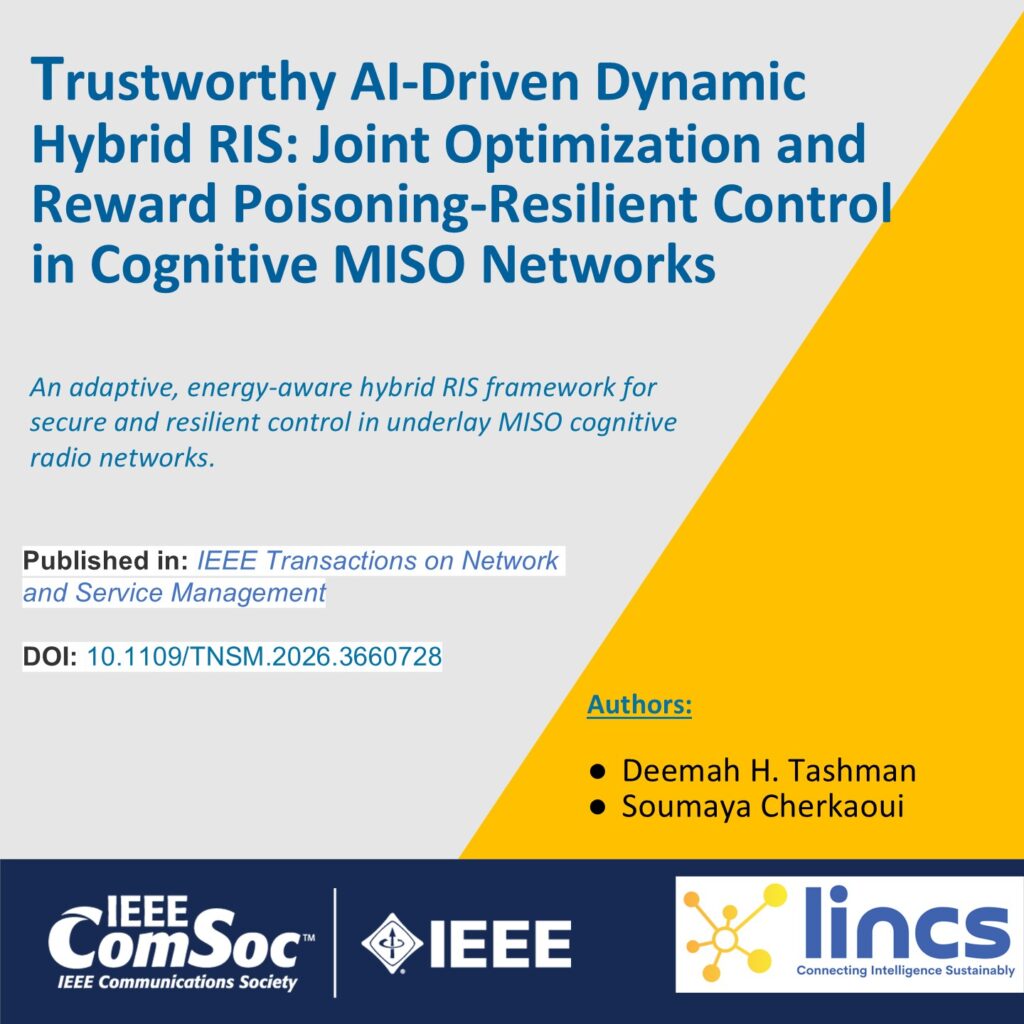
New paper accepted in IEEE Transactions on Network and Service Management 

Quantum optimization shows potential as a powerful tool for enhancing resource allocation efficiency in Open Radio Access systems (Open RAN) A D-Wave quantum computer equipped with a quantum annealing processor. Photo credit: D-Wave Quantum Inc.   Open Radio Access Networks (Open RAN) are emerging as a key architectural approach in next-generation mobile networks. One of

New paper accepted in IEEE Transactions on Network and Service Management  Read More »

Détection d'utilisateurs actifs assistée par la mécanique quantique pour le système CD-NOMA économe en énergie dans les réseaux de radio cognitive.

As wireless networks evolve toward the 6G era, they face growing challenges in managing the immense number of connected devices while maintaining energy efficiency and spectrum utilization. In a recent IEEE IWCMC 2025 publication,  “Quantum-Aided Active User Detection for Energy-Efficient CD-NOMA in Cognitive Radio Networks,” Deemah H. Tashman and Prof. Soumaya Cherkaoui propose a quantum-enhanced approach for detecting active users in Cognitive Radio Networks – a key step in optimizing communication and reducing interference.

Détection d'utilisateurs actifs assistée par la mécanique quantique pour le système CD-NOMA économe en énergie dans les réseaux de radio cognitive. Read More »

Quantum GANs pour une détection plus intelligente des anomalies réseau

As modern communication networks grow in complexity, traditional anomaly detection techniques face challenges in identifying sophisticated threats such as distributed denial-of-service (DDoS) or stealth attacks. In our latest study, we explore how quantum machine learning can offer a new frontier for cybersecurity analytics.

In our recent paper, “Enhancing Network Anomaly Detection with Quantum GANs and Successive Data Injection for Multivariate Time Series”

Quantum GANs pour une détection plus intelligente des anomalies réseau Read More »

Nouvelle publication de la professeure Soumaya Cherkaoui et de Deemah H. Tashman à l’IWCMC 2025

We extend our warmest congratulations to Prof. Soumaya Cherkaoui and Deemah H. Tashman, PhD fellow at LincsLab, on their recent publication titled:
“Quantum-Aided Active User Detection for Energy-Efficient CD-NOMA in Cognitive Radio Networks”, presented at the 2025 International Wireless Communications and Mobile Computing Conference (IWCMC) and published by IEEE.

Nouvelle publication de la professeure Soumaya Cherkaoui et de Deemah H. Tashman à l’IWCMC 2025 Read More »

Félicitations à Wajdi Hammami pour l’obtention réussie de son diplôme de maîtrise en génie informatique

We are pleased to announce that our Lincs Lab member Wajdi Hammami has successfully completed his MSc in Computer Engineering at Polytechnique Montréal. This important milestone reflects his dedication, hard work, and academic excellence.

Félicitations à Wajdi Hammami pour l’obtention réussie de son diplôme de maîtrise en génie informatique Read More »

Prof. Soumaya Cherkaoui contribue à un article de l’OIQ sur les applications de l’informatique quantique

Prof. Soumaya Cherkaoui, was recently invited by the Quebec Order of Engineers – Ordre des ingénieurs du Québec (OIQ) – to contribute to an article on quantum computing and its potential, particularly in transforming communication networks and reinventing cybersecurity.

Prof. Soumaya Cherkaoui contribue à un article de l’OIQ sur les applications de l’informatique quantique Read More »

Scroll to Top