How Can UAVs Balance Sensing and Communication in Future Vehicular Networks?
Future vehicular networks will need to do more than exchange data between vehicles, infrastructure, and users. They will also need to sense the surrounding environment in real time, supporting applications such as traffic monitoring, vehicle detection, and intelligent mobility management. This creates an important challenge for next-generation wireless systems: how can one platform provide both reliable communication and accurate sensing without wasting limited wireless resources?
Integrated Sensing and Communications, or ISaC, is one of the promising technologies being explored for 6G networks. Instead of treating sensing and communication as two separate systems, ISaC allows them to share spectrum, hardware, and transmission resources. When combined with UAVs, this concept becomes even more flexible: a UAV can act as an aerial node that supports wireless communication while also sensing vehicles from above using reflected radio signals.
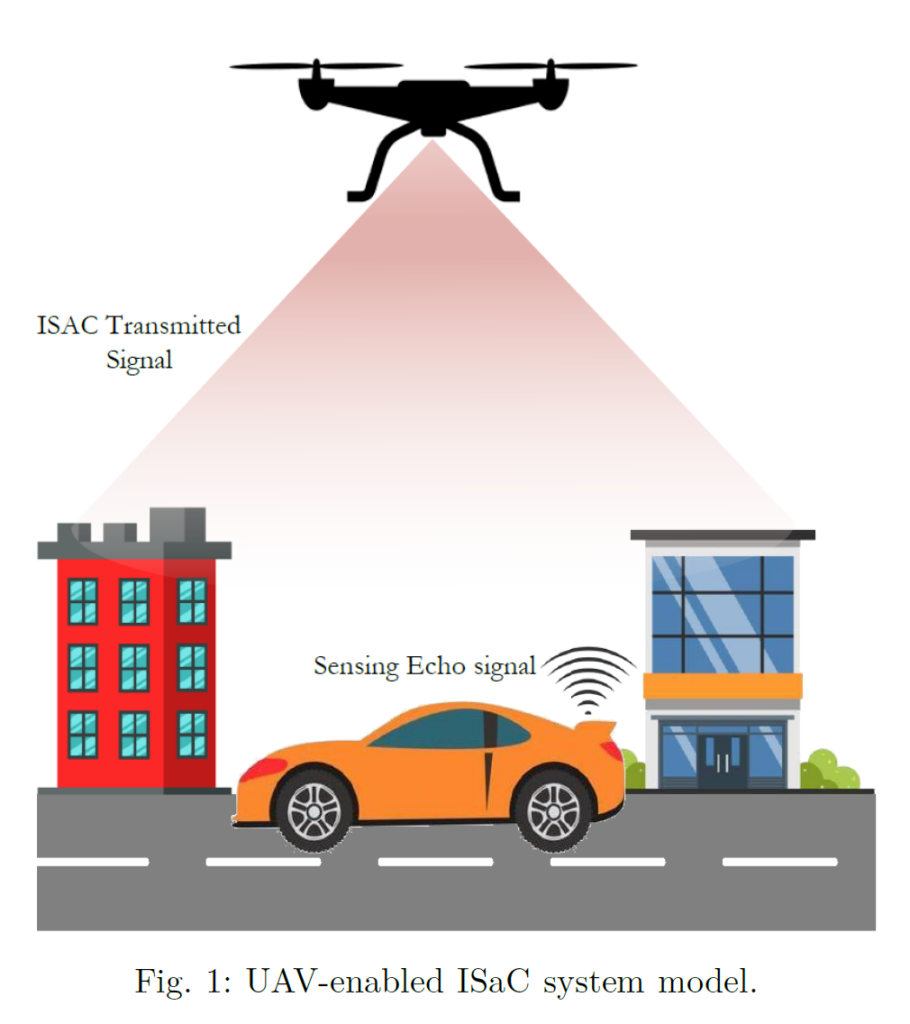
The UAV transmits an ISaC signal toward a moving vehicle. The vehicle receives communication data, while the UAV uses the reflected echo signal for sensing.
The paper contributes to this problem by:
Optimizing the time split between sensing and communication: Instead of using a fixed or equal division, the proposed framework determines how much time should be allocated to each function.
Balancing two competing requirements: The system ensures that communication meets a minimum data-rate requirement while sensing maintains sufficient reliability for vehicle detection.
Considering realistic UAV-to-ground channels: The study includes both single-shadowing and double-shadowing channel models, making the analysis more practical than ideal line-of-sight assumptions.
Improving power efficiency: Simulation results show that optimal time allocation can achieve better power efficiency than equal time allocation, especially in low- and mid-power operating ranges.
By addressing the time-sharing problem between sensing and communication, this work provides insight into how UAV-enabled ISaC systems can adapt to changing vehicular environments and support future 6G smart mobility applications.